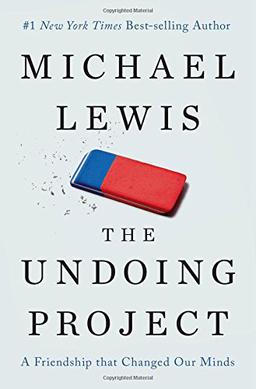
It has been a few months of sluggish reading. People say books are an escape; perhaps they are. But I have found it takes an enormous effort to dive into such different tales when your own life needs much attention. Youtube is a much more efficient escape pod…
To avoid getting caught up in a story, I sought out a non-fiction read that wasn’t too technical yet appealing in the sense that you will learn something. Michel Lewis fit the bill. I did find some parts to be pandering to the crowd…but then again, how else does a writer make dry mathematical research on the human psyche interesting?
Humans are irrational. One of my favourite quotes (mostly because its short and I can remember it) is “Passion doesn’t count the cost,” by Somerset Maugham in which he brings up the philosopher/mathematician, Pascal:
“Pascal said that the heart has its reasons that reason takes no account of. If he meant what I think, he meant that when passion seizes the heart it invents reasons that seem not only plausible but conclusive to prove that the world is well lost for love.”
This is the essence of Dr Kahneman and Dr Tversky’s thesis – although ‘passion’ is not the only reason we go gaga. ‘Regret’ is another strong emotion that can render our judgement irrational. We make decisions, not based on expected value, but on how we would feel if we lost out. How we quantify that feeling is in constant flux with context. And how the choices are framed have a huge impact on our course of action. From an emotional stand point, it all makes sense, just not rational sense.
The glass half full wording has a bigger risk-taking effect than its converse. To use a current example: “the vaccination is 95% effective” vs. “the vaccination is ineffective for 5%”. Even though it means the same thing, in the former wording, most people would believe themselves to be included in the 95% category, and mathematically speaking, that is the correct feeling. Whereas in the latter statement, the chance of being included in the population where the vaccine is ineffective is felt disproportionately higher than its actual likelihood of 5%.
Our lives are governed under huge philosophical statements of our ability to think straight: “Law is reason free from judgement.” “Markets are perfectly rational.” Are they? It is hard now to answer this question rationally, when we have learned that our judgement is inherently flawed. Context, again, is vital in understanding our decision-making process. (Read: “Come As You Are” by Dr Emily Nagoski).
And as always, words matter, just as much as actions. For words can inspire an action or cause a reaction. This is, statistically proven.
“Happy people did not dwell on some imagined unhappiness the way unhappy people imagined what they might have done differently so that they might be happy. People did not seek to avoid other emotions with the same energy they sought to avoid regret. When they made decisions, people did not seek to maximize utility. The sought to minimize regret.”
“…learn to evaluate a decision not by its outcomes – whether it turned out to be right or wrong – but by the process that led to it. “
“The big choices we make are practically random. The small choices probably tell us more about who we are. Which field we go into may depend on which high school teacher we happen to meet. Who we marry may depend on who happens to be around at the right time of life. On the other hand, the small decisions are very systematic. That I became a psychologist is probably not very revealing. What kind of phycologist I am may reflect deep traits.”
-Amos Kahneman
 JohannaAirth
Leave a comment