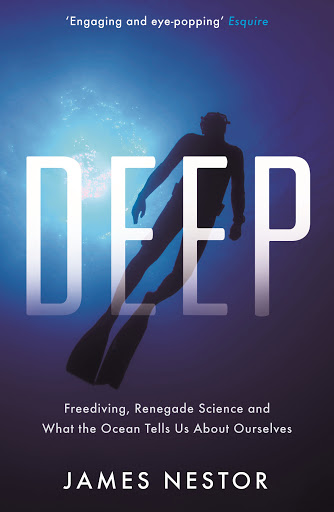
It is incredible to think we have managed to explore outer space but not our own Mariana Trench. While we can’t dive down to those levels, our bodies CAN, go deeper than we once believed. And here is why: once your body is deprived of oxygen, our mammalian “Master Switch of Life” kicks in – our spleen releases oxygen rich blood, (never knew why it was there until now…), blood is pulled from our extremities and pumped into major organs. The larynx closes-up so we don’t accidentally breathe in water while under the influence of ‘pink cloud’ hallucinations or, unconscious. And we can survive in that state for several minutes, until the body is awoken for one last effort to live, the last gasp.
I remember reading somewhere that throughout the evolutionary process, it takes more effort to ‘erase’ a genetic code, than it is to ‘evolve.’ It is why we still have wisdom teeth, tailbones, and why males have nipples. The “Master Switch of Life” can only be some remnants of a very distant past that is still hard-wired in our code; life from water. And indeed, as Nestor reminds us, we begin life gestating in a salt-water like liquid.
While the book starts off on the competitive side of free-diving – of ego-filled desires to breathe longer than the next dude, it veers, or evolves if you will, to a meditation you can unlock while holding your breath. Free diving, at it’s core, is an embracement of the ocean. Diving deep enough to swim with whales, is one such experience.
It was a strange coincidence, having just read of the bloody hunt of the sperm whales in Moby Dick. I believe, Melville too, held whales in high esteem; the majority of the book is a study in cetology, and the gruesome nature of whaling. And while Melville balances between outright satire and aloof recognition of human folly in his epic tragic-comedy, Nestor instead probes our inner consciousness. He has given us the science, sells the mystery of the deep, and leaves off before he outright asks: so what will you do about it? Because, since Melville’s time, science has progressed, making our human lives considerably safer, and more convenient – but still at the cost of our oceans.
Nestor writes:
A human body generates around 100 millivolts (a measure of potential energy). If all the electricity in a person’s body could be harnessed and converted to light, the human body would be sixty thousand times brighter than a comparable mass of the sun. Pound for pound, you could be brighter than the brightest star in the solar system.
We have all that potential energy within. It is a hopeful thought: perhaps there is meaning to our being sentient. Whales, are theorized to be as well. So what will we do about it?
“This ooze of microscopic skeletons blankets more than half the ocean floor. Billions of years ago, when the ocean covered the planet, ooze coated what is now land. Look around and you’ll see its remnants everywhere. The pyramids of Giza were built using limestone, a sedimentary rock made up of ooze. London’s Houses of Parliament and the Empire State Building are also built using limestone. The concrete sidewalk in front of your house is filled with ooze. You probably brushed your teeth with ooze this morning. (That white stuff in toothpaste is made from calcium carbonate, a chalky compound composed partly of ancient phytoplankton skeleton’s.) The silicon in computer chips that power the e-readers on which some of you are now reading these words come from the same siliceous microscopic shells that oozed on the seafloor millions of years ago. Our world is built on microscopic bones.”
 JohannaAirth
Leave a comment