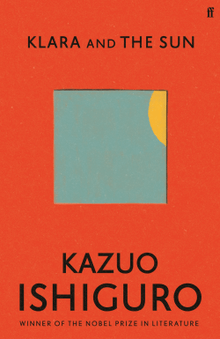
The story begins with a mother and daughter who are living out the consequences of a futuristic dilemma. The wealthy are afforded with a choice to enhance their children to meet the intellectual demands of the new world. However, it is a huge gamble. A family has rolled the die and lost heavily already. They have chosen to double down, this time for their younger daughter Josie, and things are looking bleak.
This is where Klara is bought, from a window display in a shop. She is the Artificial Friend for Josie – to help her cope on bad days. Klara is programmed to observe and learn the best way to comfort the human in her charge. She quickly learns that love is confusing, and through her child-like wonder, we explore the different, and often unexplainable, expressions of love. Ishiguro once again transforms himself into yet another unique narrator, and puts forward huge questions: what does it mean to love someone? What defines the ‘someone’ we love? And can it ever be an extension of programmed sentience?
One of the forms is expressed through mothers. Josie’s mother took the gamble and now pays for it dearly. In contrast, the mother next door had refused the procedure for her son, Rick. She regrets her decision and tries to make it up to him. Which choice is love?
Another harrowing example is when we learn of Mother’s scheme to prepare Josie’s replacement. She has decided she needs her daughter’s continued presence, in some way shape or form. Opposing this is Father, whose love is expressed through indecision – his morals in conflict with his grief.
Then, the preciously devoted love between Josie and Rick. In their naïve hopefulness to remain together despite social forces that are pulling them apart, I am reminded of the purity of a first love. (Which is equally a challenge for Klara to comprehend due to teenage outbursts…)
In my previous post, I touched upon the place-less, time-less, race-less aspects of the story that makes it wonderfully universal. There is, however, a spotlight on a social class system that imposes an oxymoron – predetermined choice, for those who can’t afford choice.
Hope – is what affects our decisions. It is a belief that chance will be calculated differently ‘this time.’ Not being afforded hope for a better life is what causes a violent social-political change that brews in the story’s background. What makes Klara ‘human’, is that she too, is hopeful. She believes that because the sun provides her with nourishment (solar power), the same should work for Josie. This conclusion based on her observations: i.e., it is rational to her. But from a human perspective, it seems …well irrational. Yet those who love Josie want so much to be hopeful, they too, chose to believe.
Love is all things irrational – it is hope and fear. It requires a daily leap of faith. Yet it is also, very real; it is action and determination. And the noblest of forms come from a place of selflessness; and because Klara is just that, intelligence without ego, she can offer Josie the rarest of its kind.
And she chooses to do so.
“At the same time, what was becoming clear to me was the extent to which humans, in their wish to escape loneliness, made maneuvers that were very complex.”
‘The heart you speak of,’ I said. ‘It might indeed be the hardest part of Josie to learn. It might be like a house with many rooms. Even so, a devoted AF, given time, could walk through each of those rooms, studying them carefully in turn, until they became like her own home.
 JohannaAirth
Leave a comment