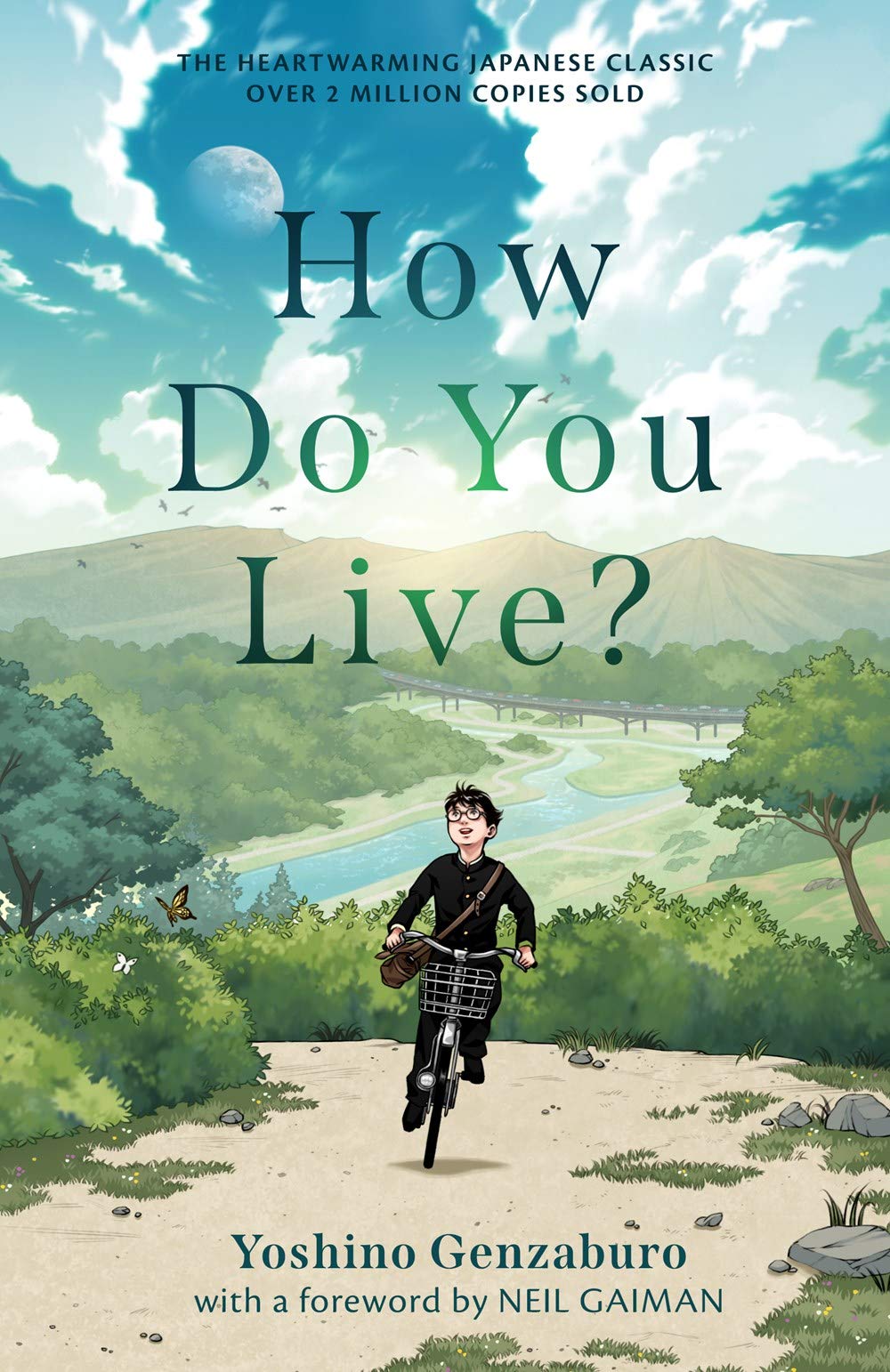
Originally written in 1937 during pre-war Japan, this is a simple story of a 15 year old boy, Jun’ichi. All schools, no matter time, place or status, are a microcosm of social and ethical problems; this is another iteration of the awkward navigation through middle school. What makes the story special, however, are the occasional interruptions: of ethical essays, and scientific methods, how to question the world we live in, as Copernicus and Newton had, and of the courage needed to be the best possible version of ourselves.
In his forward, Neil Gaiman wrote of the alternating storyline and essays, and compared it to that of Moby Dick. He notes that some readers enjoy one aspect over the other, but take either away and it would be a lesser novel. (Very true, said Tolstoy as Natasha’s romantic storyline interchanges with Pierre’s discourse on realism in War and Peace.) But Yoshino’s How Do You Live, is much more compact, and simpler; the big questions are posed to nurture the inherit kindness and innocence of the protagonist. I much prefer to liken it to The Little Prince. It is for children. And for the adult readers, it serves as a reminder to shed our protective layers of cynicism.
For me, this book has always been a gem, though I had quite forgotten all about it! I read the book in Japanese, only half understanding its arguments, if at all, and it all came flooding back when I read it in English, 20 years later. It was the Proustian madeleine; dipped in tea, the simple taste of it brought forward a hidden memory. I now firmly believe you don’t remember in language; you remember by context. And so flooded a story – though not quite Remembrance of Things Past.
I was home for the summer from college. I had started going out with the boy who lived two doors down. We got reacquainted when our local middle school friends threw a party – most likely involving karaoke. He walked me home, and that was how it started. Sometime during the summer, he came over with a shopping bag full of his old books for me to read! Now, Japanese books are uniform in size, with a maximum of about 300pgs to one volume. The Murakami novel 1Q84 (coincidently, inspired by said Proust title) is broken up into six volumes. And it must be said; the size is ingenious for those who still lug around physical books. I was told once it was designed so it slipped into kimono folds. I digress.
There must have been a hundred books in that bag. I read all that I could before the summer’s end. There were whole series of manga, mixed with classic Japanese literature. But this little book was on the top. And I now remember him saying I should read it first. It was one of his favourites, and it had changed how he viewed the daily choices, on how to be kind and thoughtful.
The irony of both stories – Yoshino’s and my summer love, is that though it is meant for the youth, it is not appreciated by the very youthful. I cut both stories short and left for New York in September. And I hadn’t thought of it since.
So now, dear reader who has made it thus far over a book journal entry – hear this! Through this awakened memory I have gleamed: there is something sacred about a person’s favourite book. Especially that of a reader’s, such as yourselves, who have come here to read about books. When someone offers to share with you their favourite book, know you have been trusted with a great secret. It is like a little guidebook through their soul, or at the very least, their library. And never leave it to read later; it should jump the que that is piling up on the nightstand. And be mindful of those you share your favourite to. If they don’t read it, they are not willing to put in the effort of getting to know you.
There! A little answer to the big titular question.
How do you live?
If we didn’t have the power to follow the voice of reason, why would we taste the pain of remorse? It’s hard to admit our mistakes. But in the pain of our mistakes there is also human greatness.
That is why I think the first, most basic step in these matters is to start with the moments of real feelings in your life, when you heart is truly moved, and to think about the meaning of those. The things that you feel most deeply, from the very bottom of you heart, will never deceive you in the slightest. And so at all times, in all things, whatever feelings you may have, consider these carefully.
 JohannaAirth
Leave a comment