Ikigai – the Japanese philosophy of living life with purpose, has been a recent passion project of mine. It all started when I wrote an article of what ageing gracefully in Japan looked like. Japan’s age demographics have been shifting for decades, and now the country has entered a “super-aged” society, with senior citizens age d 65 and above account for 30% of the population. But this is no longer a Japan-only trend; globally, we are living longer lives. By 2050, it is predicted that the population of those 60 years old and above will double to 22%. I believe Japan’s experience can offer insight and inspiration to other countries which are now facing a demographic shift.
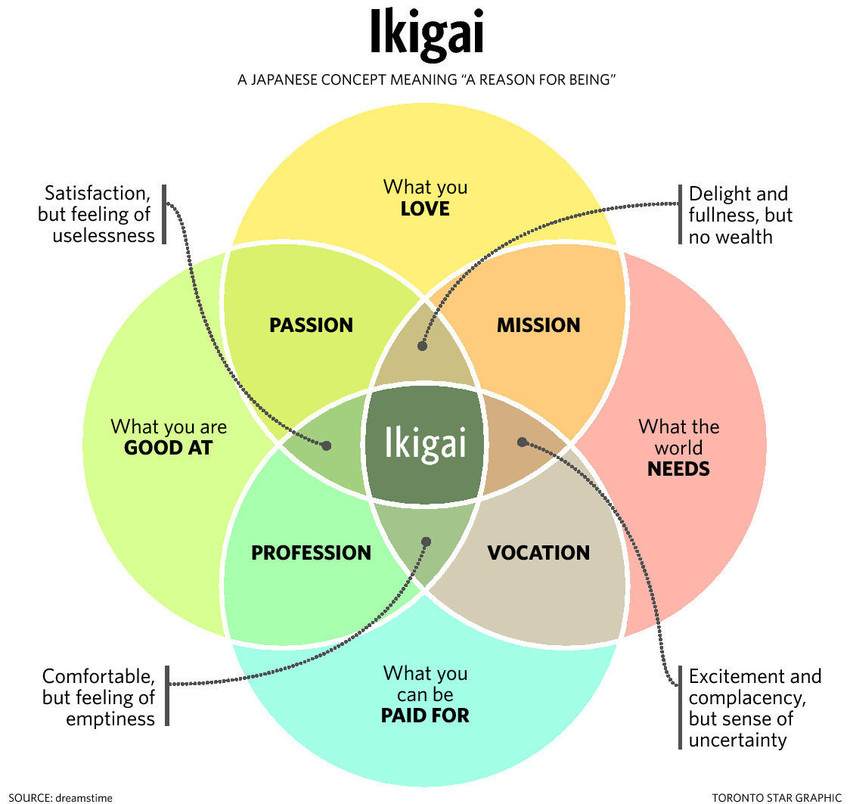
I read this book as a part of my research. It was interesting to read the astute author’s interpretation of the Japanese philosophy of Ikigai. They broke down the philosophy into components that are tangible to the Western minded and stayed away from lazy explanations using broad strokes of Zen underpinnings. Ikigai – as the authors define it, is the center of a venn diagram in which all criteria are satisfied: what you love, what the world needs, what you can get paid for, what you are good at.
The book goes into the psychological benefits of having an ikigai, siting various schools of thought in philosophy and research in psychology. I loved the rigorous categorization, explanation, and examples of this topic, and found it to be very thorough. The book also goes into the science of healthy diet, exercise, living stress-free, and community – which is perhaps a bigger contributing aspect of happiness then many believe.
I loved reading the stories of the Okinawa community. The islanders of Ogimi (a blue zone) are busy either tending their own gardens or attending each other’s birthday parties. There is a sense of celebrating each day together. Compare this to a serious situation in South Korea, in which its elderly citizens are committing suicide due to loneliness and sense of lost purpose.
What if you lost your ability to act out your ikigai. Does it mean that your life is now without purpose? No! Not only is that absurd, but it is also the reason people feel depressed, after retirement or child-rearing.
This is where I think the book missed the point: Ikigai is an activity that is held lightly so that it pivots along with you throughout various stages of life. I disagree that an ikigai has to be a profession you get paid for. It is simply, any reason that gets you excited about waking up. An ikigai should be playful, and in balance with other life needs (eg. financial, familiar).
What I believe we need, is inspiration to be old and live joyously. I believe if we share stories of those living with ikigai, it will bring about an infectious chain reaction – much like the spreading of laughter. To that end, my partner and I will be launching The Ikigai Collective, in which we spotlight people who we believe are living everyday with purpose. Stay tuned!
“Existential frustration arises when our life is without purpose, or when that purpose is skewed…however, there is no need to see this frustration as an anomaly or a symptom of neurosis; instead, it can be a positive thing – a catalyst for change.”
“I see badly, I hear badly, and I feel bad, but everything’s fine”
Jeanne Calment, 122 years old
 JohannaAirth
Leave a comment